New Minor
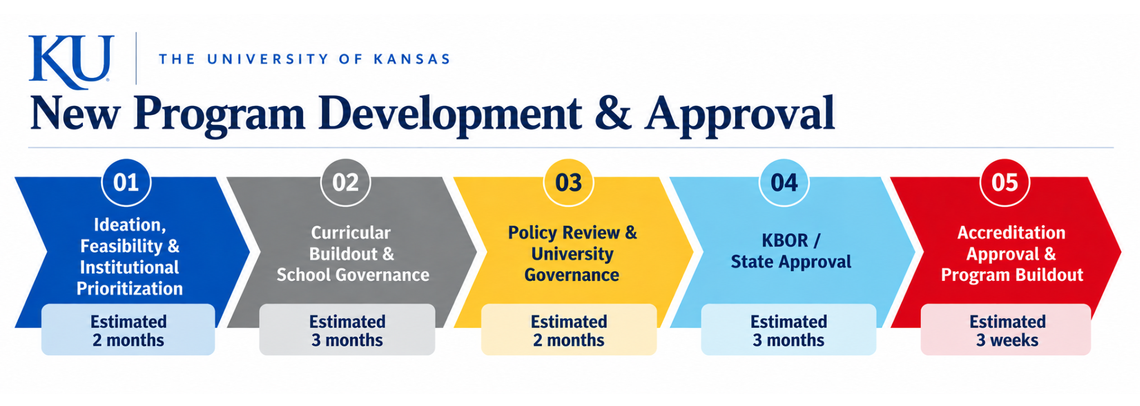
A dependent minor is a minor that has a corresponding major/degree already in existence at KU. These minors are not required to go to KBOR for approval.
A freestanding minor is a minor that does not have a major in the same area currently in existence at KU. These minors are required to go to KBOR for approval.
Ideation:
To propose a new minor, contact your school/college CIM representative to complete and submit a new program pre-proposal form. As the initiator, you must work with your local CIM representative to complete and submit the pre-proposal form. Once submitted, the pre-proposal is then routed to the proposing unit’s Dean’s office for consideration and approval before moving to the next step.
Feasibility
Once the pre-proposal receives Dean’s approval, a feasibility study is launched. The feasibility study will look at Lightcast data and evaluation by the KU Strategic Analysis & Feasibility team. A copy of the proposing unit’s most recent Academic Program Review report is also shared with this team for additional background. This team reviews the pre-proposal and Lightcast data for strategic alignment with KU’s mission and goals, risk analysis, outcomes and impact, intangible benefits, sustainability, and institutional prioritization.
The Strategic Analysis & Feasibility team will communicate with the Dean of the school to share their feedback on the proposal and for the Dean to make a final decision with the additional information provided. If approved by the Dean, the pre-proposal is then routed to the CIM representative/initiator of the proposal. The full proposal will then be available to the initiator.
Curricular Buildout and School Governance
The initiator and faculty sponsor will complete the full program proposal. The program proposal will include the following pieces of information:
- Catalog degree plan
- Course list of curriculum required
- High impact practices
- Anticipated costs
- Faculty profile
- Student profile
Once complete, the full proposal form is routed to the Academic Program Coordinating Committee (APCC). Evaluation rubrics are used as a guide to ensure equal and unbiased review. Completed rubrics are uploaded within the CIM system before being routed back to the initiator to share with the sponsoring faculty before sending on to College/School governance. The evaluation rubrics are available at Resources | Academic Affairs (ku.edu)
A faculty representative from the originating school or college is highly encouraged to attend the proposal’s read at APCC to provide a brief overview of the proposal and answer any related questions from the committee. The AD may serve in this capacity if the faculty member is not available.
After review by APCC, the proposal is returned to the initiator to connect with faculty sponsor regarding any feedback received from APCC. Once feedback is reviewed and any desired changes are made, the full proposal form is routed as outlined in the proposing unit’s college/school-level procedures. As timelines vary, additional work is being done on the proposal by other units.
- Academic Operations is alerted if the proposed concentration leads to licensure
- If the proposed concentration will be offered online or in a hybrid format, Academic Affairs (AA) will begin an initial Quality Matters (QM) review and notify Jayhawk Global of the upcoming program.
For Free-Standing Minors: Academic Affairs begins working with department on starting to complete the KBOR proposal form.
Policy Review and University Governance
Following review and support from the academic unit’s governance body, the proposal is routed to either Undergraduate Studies or Graduate Studies for policy review.
Once all policy reviews are complete, the proposal receives a CIP code assignment from AIRE as well as a final catalog and course review by the Office of the Registrar (OUR). If changes were requested by APCC, the program will return to APCC for a second read, and if not, then it will be sent to the Provost for a final determination to move forward.
KBOR/State Approval (Free-Standing Minor Only)
After the Provost approves the program, the proposing unit will work with Academic Affairs to submit the KBOR program proposal form to the Kansas Board of Regents. The proposal form is due approximately six weeks before the first meeting to be added to the agenda. New program proposal have a first reading from the Council of Chief Academic Officers (COCAO), one reading by the Council of Presidents (COPS), and one reading by the Board Academic Affairs Standing Committee (BAASC) before being sent to the full Board for approval. The approval process through the Board of Regents takes two-to-three months. Program representatives will be asked to attend COCAO and BAASC to present their programs.
Final Steps
If approved by the Provost, Academic Affairs will notify the Higher Learning Commission (HLC) and if needed, seek HLC approval for the new minor. Dependent minors do not need to go to KBOR for approval.
Upon approval of the HLC, Academic Affairs will internally notify the following parties that the new concentration has received all approvals:
- College/School Dean
- Financial Aid
- Undergraduate or Graduate Admissions
- Undergraduate or Graduate Studies
- International Affairs
- Student Information Systems
- Office of the Registrar
- AIRE
- Business & Financial Planning
Each unit will undertake its requisite work to ensure the minor is available for enrollment and will notify the Dean’s Office when such set-up work is complete.
New minor cannot be advertised until the college/school receives the final approval notice from Academic Affairs.